

Introduction
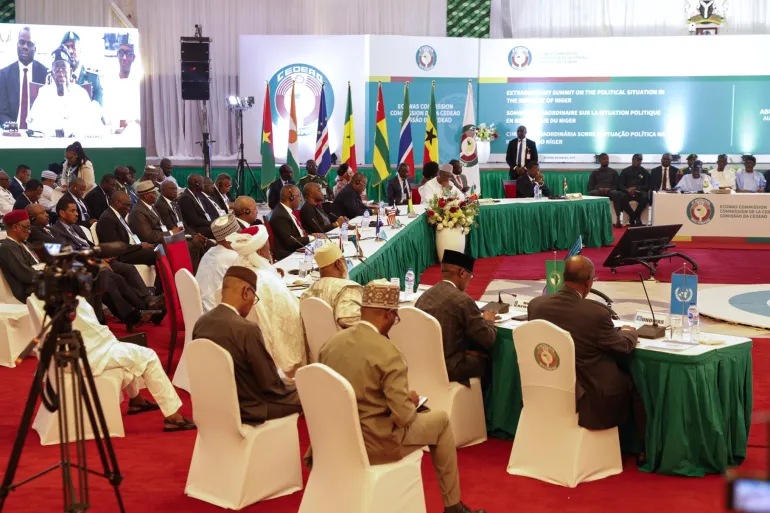
The Economic Community of West African States (ECOWAS) celebrates its 50th anniversary in 2025, but the regional bloc faces unprecedented challenges. Surging jihadist violence, a wave of military coups, and the withdrawal of key members like Burkina Faso, Mali, and Niger threaten its mission of economic integration and peace. This article examines ECOWAS’s struggles with security threats, political instability, and shifting alliances—and whether it can adapt to survive.
(Source: Reuters – ECOWAS at 50)
1. Escalating Jihadist Violence in the Sahel
West Africa’s Sahel region has become a global hotspot for terrorism, with al-Qaeda and ISIS-affiliated groups expanding their reach.
Key Crisis Points:
✔ Nigeria, Burkina Faso, Mali, and Niger suffer frequent attacks, causing mass displacement.
✔ The Global Terrorism Index reports that the Sahel accounts for over 50% of global terrorism deaths.
✔ ECOWAS struggles with limited resources, poor coordination, and member-state withdrawals, weakening counterterrorism efforts.
(Sources: Conducive Space for Peace, The New Indian Express)
2. Wave of Military Coups and Democratic Decline
Since 2020, West Africa has seen multiple coups, undermining ECOWAS’s democratic principles.
Recent Coups:
- Mali (2020)
- Burkina Faso (2022)
- Niger (2023)
ECOWAS Response:
✔ Sanctions and suspensions imposed to pressure a return to civilian rule.
✔ Critics argue ECOWAS is too influenced by Western powers and ignores root causes of instability.
(Sources: BBC – ECOWAS Sanctions, Wikipedia – ECOWAS Coups)
3. The Alliance of Sahel States (AES): A New Regional Bloc?
After their suspension, Mali, Burkina Faso, and Niger formed the Alliance of Sahel States (AES), signaling a major shift in West African geopolitics.
AES Key Actions:
✔ Joint military force to fight jihadists.
✔ Shared passport system for easier regional movement.
✔ Reduced reliance on Western allies, turning instead to Russia for security support.
This realignment challenges ECOWAS’s influence and raises questions about regional fragmentation.
(Sources: Business Insider Africa, WATHI)
4. Can ECOWAS Regain Stability?
Despite setbacks, ECOWAS remains committed to regional security and dialogue.
Possible Reforms Needed:
✔ Stronger conflict prevention mechanisms
✔ More inclusive decision-making
✔ Balanced foreign policy (less Western dependence)
ECOWAS Commission President Omar Alieu Touray has called for unity, but analysts say structural reforms are crucial for survival.
(Sources: AP News, BusinessLIVE)
5. Conclusion: ECOWAS at a Crossroads
As ECOWAS turns 50, it stands at a critical juncture. Rising jihadist threats, military takeovers, and the AES split test its future. To remain relevant, ECOWAS must:
✔ Reform its governance approach
✔ Improve counterterrorism cooperation
✔ Rebuild trust with suspended members
The next decade will determine whether ECOWAS can adapt—or risk fading into irrelevance.

